Monday, April 23, 2012

Got Duct Tape?

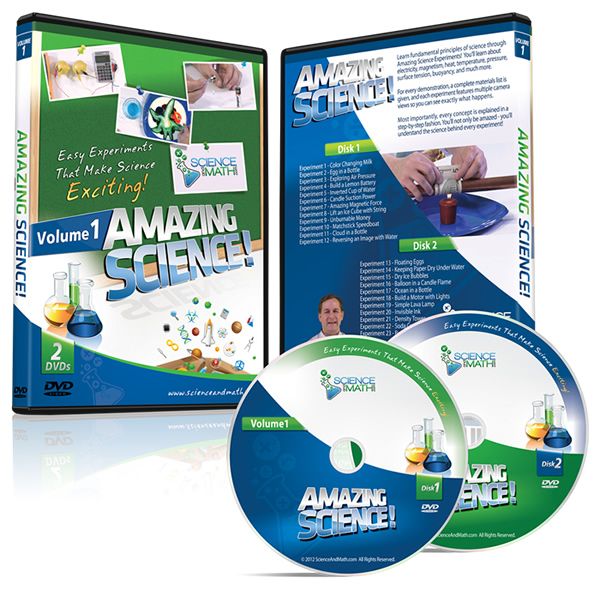
"Hello, my name is Jason from scienceandmath.com!"  So begins the friendly greeting of each of 23 different science experiments featured on Volume 1 of Amazing Science!  If you have common household items like duct tape, eggs, matches and magnets, you are ready to go. 

Jason Gibson "has earned advanced degrees in Engineering and Physics, worked as a Rocket Scientist for NASA, and has a passion for teaching Science and Math!"  Unlike some engineers, Jason does have some personality and does not talk over your head.  His tone is conversational and his attitude is happy.  He shows and explains the materials you need for each experiment, and then goes on to demonstrate some amazing feats of science.  With the use of  several camera angles (including the ones like they use in cooking shows, top down), you get clear pictures of what is happening in the experiment.  


Some of the experiments we had seen and done before:  Egg in a Bottle, Lifting an Ice Cube with a String, Keeping Paper Dry Under Water, and Invisible Ink.  A couple of the experiments went right along with our Apologia Physical Science and General Science texts:  Matchstick Speedboats, Floating Eggs, Balloon in a Candle Flame, and the Density Tower.  And a couple of them were brand new and pretty impressive:  Building a Lemon Battery, Making a Cloud in a Bottle, Building a Motor with Lights and, one of my favorites, Dry Ice Bubbles!  There are more, but you get the idea!

Mr. Gibson does a good job of presenting each experiment in an organized way.  I liked how his props were often colorful so that you could really distinguish all the parts.  We've done Color Changing Milk before, but he got even better results than we did, so it was fun to watch.  After each demonstration, he goes on to explain the science involved, covering "electricity, magnetism, heat, temperature, pressure, surface tension, buoyancy and much more."  The experiments average about 10 minutes, though a few are closer to 15 to 20 minutes long.  My kids found some of the explanations slightly redundant, but the information was always good and the demonstrations themselves were great.

This volume appears to be religion-neutral -- with no mention of God or evolution that I picked up on.

You can get all 23 experiments together on 2 DVDs on their website for $19.95, a $5.00 discount from the retail list price.  Or, you can download all the experiments to your computer for only $17.99 and not have to worry about shipping!  Besides Amazing Science!, www.scienceandmath.com have other math, science, physics and chemistry DVD sets available.  You can also get free videos e-mailed to you if you join their mailing list.

I think these DVDs would be good for kids who LOVE science as well as those who STRUGGLE with science.  Seeing some of the demonstrations might be a good way to provoke interest in your children who are normally less interested.

Disclaimer:
As part of the TOS Homeschool Crew for The Old Schoolhouse Magazine, I received this 2-DVD set for free in exchange for an honest review.  

Tuesday, April 3, 2012

God's Nature Reflects God's Nature

Today I walked down a single block in a very small town.  On my right was a lovely landscaped retention pond with a fountain bursting forth from the center.  Nearby a tall white heron stalked its dinner.  On my left, in an even lovelier ditch -- lovelier for its wildness -- was a mini-woodpecker.  I've never seen one on the ground before...taking a break from pecking.  His Clorox-white feathers were startlingly clean, his brown feathers ruffling in the light breeze.  Just feet from him, waddling in the tiniest puddle were three ducks, as alike as they were different.  Each had its own pattern of brown and white, all distinguishable as separate and individual.

Hidden by his very stillness, a blue heron stood tall behind these diminutive ducks, thinking I could not see him.  I am so glad I saw him -- and all of the rest of those creatures.  They reminded me of my God's infinite creativeness, His perfection, and His power.  "God is in the details."  Why make so many different kinds of birds?  Why not just one?  And why not all the same color?  Because He could.  Because it is part of His nature.  Because He could not make a world devoid of COLOR and full of care.  He did not create ugly.

When you look in the mirror you can know that you also are a part of His masterpiece.  You are unique and specially designed.  God did not create anyone else who is exactly like you.


For the invisible things of Him from the creation of the world are clearly seen, being understood by the things that are made, even his eternal power and Godhead...Romans 1:20a

Friday, March 16, 2012

Literary Temptations

My Dear Wormwood,
How do you think you will ever learn anything about British Literature if you don't read any?  And if you are going to read some, how about my letters, appropriately entitled The Screwtape Letters?  And if you are going to bother to read them, why not study them, analyze them for their literary qualities (I assure you there are many), and make sure that you digest every word I have sent you?  You can do all that more easily if you use the Literature Guide provided by Progeny Press!  Now get to work, you scruffy little demon!
Your mildly affectionate uncle,
Screwtape
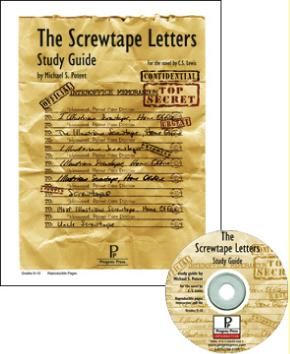
Okay, so I made that letter up.  But, Screwtape has a great idea there.  If you'd like help in your homeschool with analyzing literature, Progeny Press study guides are an awesome resource!  I was privileged to receive the guide for The Screwtape Letters by C.S. Lewis, but there are many other options available, including American, British, Historical, World, and Christian Literature.  A few of the titles covered are:
The Adventures of Huckleberry Finn
The Call of the Wild
The Scarlet Letter
The Lord of the Rings
A Tale of Two Cities
Hamlet
Romeo & Juliet
The Hiding Place
Number the Stars
The Lion, the Witch and the Wardrobe
The Bronze Bow
and many, many more in their catalog
The study guides are offered in booklet ($21.99), CD ($18.99), or e-mail .pdf formats ($18.99).  They also sell the novels; this one would have cost $13.99.  I received the .pdf version which included a 75 page Student Guide, plus a 10 page Answer Key for the teacher/parent.  This version is interactive on Windows or Mac computers.  I could also read the file on my iPad, but not "interact" with it.  (The guides for 4th to 12th grades are interactive, but the kindergarten through 3rd grade are read-only.)

Progeny Press recommends each of their guides to cover from 8 to 10 weeks of study.  Generally, students should read the entire novel the first week and then use the guide to review, analyze and gain insights into what they read.  

The Screwtape Letters guide began with a brief synopsis of the novel, followed by information about C.S. Lewis, the author, and a few pages of background on the Battle of Britain which plays a role in the story.  These details are followed by a selection of pre-reading activities which can be assigned before reading or during that first week of reading.  Then, you are ready to get down to business.  For each section, in this case, about 4 "letters" (chapters) at a time, students are asked vocabulary questions in multiple choice, matching, fill-in-the blank, synonym/antonym, and word search forms.  These are fun for the kids to fill in on the computer.  

Vocabulary segments are followed by a plethora of thought-provoking questions on all levels.  Some elicit what the student knows about what happened (why did Screwtape write to Wormwood?) and others deal with literary analysis (how is parody used?).  Some can be answered with a word or phrase, others require paragraphs.  Go as deep as you want.

Each section then lists optional activities such as papers, reports, and projects that could be chosen to add to all that learning.  At the end of the guide were also a large number of final essay topics ranging in varying lengths required.  At the very end was a list of additional resources.

Personally, I don't think you could (or should) do every question/project listed -- there is so much -- I prefer to think of it as "so much to choose from!"  I had my kids work through the vocabulary, then asked some questions orally and had them fill in a few "online."  We did not attempt every question by any means!  Although we have not begun it yet, I really liked the final essay idea of writing your own letter (as Screwtape) giving Wormwood advice on how to tempt you!  That would take some real introspection and also biblical insight.


Speaking of the Bible, Progeny Press is a Christian company and their guides present literature from a Christian perspective.  This was easy to see with The Screwtape Letters because it is a Christian work, but this is also true with their other 100+ titles.

Although I have a background in English Education, guides like this one are a great time-saving device for me!  The questions are clear, well-thought out, and make your students think.  Hopefully, that is temptation enough for you to try one (or more) guides out for yourself!

As a member of the TOS Homeschool Review Crew, I received this guide free in exchange for an honest review.  To see what other TOS reviewers had to say, click here.

Saturday, March 10, 2012

If I Like It, So Will You!

The "if I like it, so will you" argument could be classified as a "false cause" argument.  Just because I like something does NOT mean that you will. Your tastes, needs and desires could be very different than mine.  Yet this kind of argument is found all around us in advertising -- if a particular football hero, movie star or political figure says "I like this," we are expected to fall in line and buy that beer, make-up, or ideology too!  In our everyday lives, we need to be aware of the fallacious arguments that surround us, so that we will not be taken in.  The Bible says:
Behold, I send you forth as sheep in the midst of wolves: be therefore wise as serpents, and harmless as doves.  Matthew 10:16
Put on the whole armor of God, that you may be able to stand against the wiles of the devil.  Ephesians 6:11
Be sober, be vigilant; because your adversary the devil, as a roaring lion, walks about, seeking whom he may devour...  1 Peter 5:8
Casting down imaginations [arguments], and every high thing that exalts itself against the knowledge of God, and bringing into captivity every thought to the obedience of Christ... 2 Corinthians 10:5
But sanctify the Lord God in your hearts, and always be ready to give a defense to everyone who asks you a reason for the hope that is in you, with meekness and fear...  1 Peter 3:15  
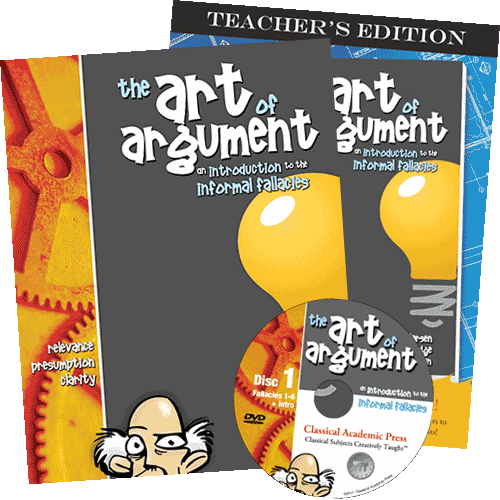
The Art of the Argument: an Introduction to the Informal Fallacies is a great resource for teaching your middle and high school age children about reasoning logically, identifying false arguments all around, and exchanging real debate for annoying bickering.

This curriculum breaks down 28 fallacious arguments into basic three types:  relevance, presumption and clarity.  Many of the fallacies are given their Latin names, so you'll be learning some hoity-toity language to go along with your lessons in logical reasoning.  

The student text offers description, discussion, and examples of each type of argument, often accompanied by a skit between the anciently famous philosopher Socrates and two modern-day students.  This is followed by vocabulary/definition questions, and both short and longer essay questions.  The teacher's manual is the student manual with the answers provided in the appropriate blanks.  In the front cover of the student text are listed the Four Key Questions (for deciding if an argument is false), and a list and description of all the informal fallacies.  It would have been nice if this same chart had been provided in the teacher text for easier reference.

We all have our own style, and mine tends to be more oral than written, so we could have actually gotten along with just the teacher text.  But, I do think that most families would prefer to have the student write, so the student text would then be very handy.  I was given a sample of the DVD series and I thought that was helpful to show me (the parent) how to lead a discussion about the arguments, but did not think my kids would find it interesting to watch all the way through.  Can I say, "unashamedly geeky," without hurting anyone's feelings?  I respect and admire the geekiness of it all, but it just didn't come across as how I speak with my kids or, more definitely, how they speak back to me.  Perhaps in a larger co-op situation it would work better.


Though my reasoning above includes Bible verses, this curriculum does not come across as overtly Christian.  Don't get me wrong, it doesn't come across as un-Christian.  More like religion-neutral.  You could certainly use this book as a jumping off point for apologetics, but in itself it is not designed for that.

Each chapter covers a lot of information, with a lot of "big words" to learn, so the lesson, although not too long,  tends toward dull.  But, the authors balanced that out.  The fun part of The Art of the Argument is the "fake ads" the accompany each fallacy.  Some of them are quite amusing (like the ad selling sandals for the purpose of swatting flies), and they really do help the kids understand the concepts under discussion.  And the main point is discussion -- being able to clearly state your argument and back it up with good reasons.

The Art of the Argument student text is available from Classical Academic Press for $21.95, the teacher's text for $24.95, the DVD set for $54.95.  Or you can bundle the set for $88.95 and save almost $13.00.  The next step is The Discovery of Deduction:  An Introduction to Formal Logic aimed at eighth grade and up.  Classical Academic Press specializes in Latin and Logic, but also produces studies for Bible, Spanish, Greek, and more.


I would definitely recommend this product.  It covers a lot of good information that everyone should know.  If you have a leaning toward classical education, then this book is probably a "must-get" for you!  And, after all, "If I like it, so will you!"

As a member of the TOS Homeschool Crew, I was provided with The Art of the Argument Student and Teacher's texts, plus the DVD sample, for free in exchange for an honest review.  See more TOS reviews of this product here.

Saturday, February 25, 2012

The Book of Beginnings - Part 3

"In the beginning, God..."

This is, again, the opening phrase of the Bible.  Although in English translations, the words "God" or "Lord" are used throughout the Old and New Testaments, there are more Hebrew and Greek names used for God in the original texts.  For example, the Hebrew word for God in this verse is "Elohim."  This is the name we have for God from Genesis 1:1 until Genesis 6:5, when we see the first occurrence of YHWH (Yahweh or Jehovah); later in Genesis 14:18 we see the name "El" ("Mighty") introduced.  

It seems to me that God reveals more and more of Himself through His names as we go through scripture/His story (history).  We get to know Him better with each new name.  Here are a few more (not all):


I love the exclusive use of Elohim in the opening chapters of Genesis because, in my opinion, that word seems to exude the idea of the Trinity.  The word "trinity" does not appear in scripture, but the idea (three-in-unity) certainly does.  Elohim is a plural noun, paired with plural pronouns like "we" and "us" (i.e., "Let us make man in our image...").  Though "the Lord our God is ONE God" (Deuteronomy 6:4), He has a plural existence as the Father, the Son, and the Holy Spirit.

We see the introduction of each part of the Trinity operating separately, but in unity, in the first 3 verses of Genesis:

Genesis 1:1 - God, the Father - created the Heavens and the earth
Genesis 1:2 - God, The Holy Spirit - moves across the face of the waters, 
Genesis 1:3 - God, the Son (see John 1:1-14; Jesus is the Word, but also the Light)


In the end, the Holy Spirit gives me the faith to believe in the Son who is the only way to the Father (Galatians 5:22-23, John 14:6).  

Sunday, February 19, 2012

The Book of Beginnings - Part 2

"And God said, 'Let there be light,' and there was light."  Genesis 1:3

I count ten times in the first chapter of Genesis that God said something and then something happened.  That is the way He made light, Heaven, Earth, grass, trees, fruit, the sun, the moon and stars, living creatures of every kind to fill the air, the land and the sea.  And finally, He created man in His own image.  Just by saying, and it was so.

Psalm 33:6-9 says, "By the word of the LORD were the heavens made; and all the host of them by the breath of his mouth.  He gathers the waters of the sea together as a heap:  He lays up the depth in storehouses.  Let all the earth fear the LORD:  let all the inhabitants of the world stand in awe of Him. For He spoke, and it was done; He commanded, and it stood fast."

God's power is amazing.  I have yet to look in the refrigerator and say, "Let there be dinner" and have dinner appear!  Yet, God made the whole universe by His spoken Word.

In John 1:1-3, we find out that Jesus is that Word:

In the beginning was the Word, and the Word was with God, and the Word was God. The same was in the beginning with God. All things were made by Him; and without Him was not any thing made that was made.

Selah (think about that).

Sunday, February 12, 2012

Meet ALEKS!

I don't usually do a lot of cut 'n' paste work in my curriculum reviews.  But, for this one, there is a lot of cool stuff I wanted you to see!  So, below you will find a full description and plenty of screen shots of the program in the words of the providers.  But, first let me tell you about my experience with ALEKS.

The name ALEKS (reminds me of Alex) sounds so friendly -- like a neighborhood pal.  And truly, this program was very user-friendly and even fun to use.  As part of the TOS Homeschool Crew, I was provided with a two month trial version for free, in exchange for my honest review.  I have never before tried a comprehensive math program that was computer-based.  I downloaded the trial version. There was the tiniest of glitches because we needed an upgrade to Java before we could get things going and that took some finessing by my resident computer expert (but that is not the fault of ALEKS).  Once that was ready, ALEKS downloaded fine.  I was given login names for myself and my two children.  I could choose any courses I liked, so I put the kids in their respective grades (7th grade math and Algebra) and I also put myself in Intro to College Chemistry just to see what it was like (uh, it was hard).  To make myself feel better, I also tried out a 3rd grade math assessment (yes, I passed with flying colors).

At the beginning of each course, the student is walked through a tutorial of how to answer questions.  ALEKS has a brilliant system for typing fractions, mixed numbers, chemical symbols, square roots, etc.  They explain how the program works and then give you an assessment test of 20 to 30 questions.  Based on how well you answer those questions, ALEKS creates a pie chart showing what areas you have mastered and what areas you need to work on.  Some areas are immediately clickable -- you choose what you want to tackle first.  Let's say, you need to complete 5% more in the area of fractions.  So, you click on that subject and you are taken to a practice problem.  You can choose to answer the problem and try to move on, or you can choose the explanation.  The explanation is detailed and multi-leveled.  In other words, if you don't understand a concept in the explanation, it is highlighted and clickable and will take you to another level of explanation, deeper and deeper.  Once you understand the concept, and you answer several questions correctly, you can see your pie pieces filling in darker and fuller.  As pie sections are filled in, you are able to move to more sections and try more difficult areas.

ALEKS covers math from kindergarten through college level and even has a way to earn ACE college credits.

I thought that the process and explanations were exceptionally well-done.  I really like the fact that a motivated student could get through this without much parental involvement and probably at an increased speed.  I think that you could definitely achieve a good level of mastery with this system.  The "artificial intelligence" of the program really seems to do a good job of tracking what you know and what you need to know.

In the maths where you must draw graphs, circles or other geometric shapes, ALEKS has a really cool way of simulating pencils, erasers, compasses, and rulers.  It was fun practicing drawing the lines and circles!

That said, I'm not sure that there was enough practice for a struggling student.  If you complete 3 problems correctly on Tuesday and "master" the concept, that doesn't mean you will remember them a few weeks later.  My 9th grade daughter felt that she would like more repetition (not that she wanted to do the work, but she felt that she would learn  better with more).  When I took the 3rd grade assessment, I got a 100% on my first try (thank goodness).  I thought that there would be a series of review questions, but instead you are expected to jump into the next level.  That is okay, but I just thought it would be nice to be able to assign some review if you wanted to.

I loved receiving weekly e-mail updates on how my children (and I) were faring.  The updates told me how much time we spent and how our pies were coming along.

I am used to spending about $70 a year for math curricula, a student book and a teacher's manual.  ALEKS is a bit pricier at $19.95/month or $99.95 for 6 months or $179.95 for 12 months.  But, if your student is a good independent learner and can finish more than one course in a year, you may be saving money in the long run.  There is a discount of multiple siblings using the program.

So, I definitely think ALEKS is worth considering.  Consider what type of learner your child is.  If they like to use the computer, are willing/happy to work somewhat independently, and motivated to move quickly (to save you money), then I think this would be a good program for you.  Below is more information from the makers of ALEKS, including a special price trial version just for you, so keep reading!  Then, to see what other TOS reviewers had to say, click here.

What is ALEKS?

Aleks LogoAssessment and LEarning in Knowledge Spaces is an online mathematics program that provides personalized learning and assessment tailored to a student's individual needs. Using artificial intelligence and adaptive, open-response questioning, ALEKS quickly and accurately determines what a student knows and is most ready to learn within a course. Learn more by watching a quick 2-minute video.

With a comprehensive course library ranging from elementary school math to complex subjects such as PreCalculus, ALEKS acts much like a human tutor to help take the stress off of homeschooling parents.


ALEKS offers highly-targeted, individualized instruction from virtually any computer with Internet access, making it a comprehensive and mobile education solution for students in grades 3-12. A subscription to ALEKS offers access to all courses and students may take as many courses as needed during their subscription period.
ALEKS is a Research-Based Online Program:
  • Complete Curriculum Solution for Math with Access to Full Course Library
  • Artificial Intelligence Targets Gaps in Individual Student Knowledge
  • Master Account - Monitor and Direct Student Progress
  • Unlimited Online Access - PC and Mac Compatible
  • QuickTables - Math Fact Mastery Program for Multiplication, Division, Addition, and Subtraction Included with Any Math Course
ALEKS has been used successfully by homeschoolers, as well as by millions of students at schools and educational institutions throughout the world. Additionally, some ALEKS course products are American Council on Education (ACE) credit-recommended, meaning students may be eligible for college credit at participating colleges.

GOOD DEAL:  Because you are a homeschooler reading this blog, you can use the ALEKS 2-month free trial (a $39.90 value). We only offer a 48-hour trial directly from our website, so this is a special offer only for homeschoolers who are new users to ALEKS.

Homeschool Banner 

Screenshots:
Student Account
Student Assessment
Assessment: Students begin in ALEKS by taking an individualized, adaptive assessment to determine what they already know and what they are ready to learn.

Student MyPie
MyPie: The ALEKS Pie summarizes a student's current knowledge and offers topics that the student is ready to learn next. The darkened portion of each pie slice represents the topics that the student has mastered and the lighter portion represents what the student has yet to learn.

Student Graphing Tool
Input Tools: ALEKS provides a free response environment and sophisticated input tools that avoid multiple-choice and require students to demonstrate content mastery.

Student Problem Two
Learning Mode: The Learning Mode provides students with practice problems, and offers explanations of topics and procedures as needed. Once a student has demonstrated mastery in the Learning Mode, the topic is added to the ALEKS Pie and new material that the student is now ready to learn becomes available.

Student Explanations
Explanations: When a student is working on a particular problem, she can access an explanation of that problem by clicking on the "Explain" button. The explanation typically provides a step-by-step solution, with commentary. In some cases, an alternative or more detailed explanation is also available.

Student Feedback
Feedback: Students receive immediate feedback and, in some cases, suggestions for correcting mistakes.

Review
Review: At any time, students have the ability to review topics they have previously or recently mastered. To view topics that were added in the Learning Mode, students can click on the "Review" button on the ALEKS toolbar and can work on additional problems for review.


Worksheets: Students have the ability to print out 16-question worksheets for additional practice or review. These worksheets are uniquely generated based on the student's current knowledge.

Student Problem Two
ALEKS QuickTables: QuickTables is a research-based, math fact mastery program for multiplication, division, addition, and subtraction.

Student QuickTables Games
QuickTables Interactive Games: Provide additional review and built-in rewards.

Master Account

Master Homepage
Master Account Homepage: Easily manage all student accounts, monitor student progress, view customized resources, and more.

Master Attendance Report
Attendance Report: Track student time spent in ALEKS per day, the topics attempted, and the topics mastered and added to the ALEKS Pie.

Master Progress Report
Student Progress Report: Track student progress made throughout the course. The blue bar represents the percentage of course material that the student has mastered during an ALEKS assessment; the green bar represents the percentage of new topics the student has mastered in Learning Mode since the last assessment; and the yellow bar represents the percentage of topics the student has yet to learn in order to complete the course.

Master Quiz Results
Quiz Results: Quizzes are automatically graded and the results are available to both the parent and student immediately. View a quiz results sample report (PDF).