The ball has dropped and the new year has dawned. I'm getting older and my New Year's resolutions are sounding a bit cliche!
I need to lose weight! I had some medical issues last year that kept me from exercising for a while and then habit grabbed hold when I was feeling better and I just never got back to it. So, today, I begin again! My husband and I walked a bit over a mile this morning just to get things kicked off. I'm going to make the kids go again with me this evening...and tonight I go back to Weight Watchers for the first time in a long time.
Starting over is hard. I was very successful with Weight Watchers a few years ago, but when I slid, I slid big! (Pun intended.) It can feel depressing and overwhelming to go back over the same ground again, but I know I need to.
There are other things on my list too, and probably more important in the grand scheme of life, but this is the one that is "weighing me down." (Too many puns?) I know that with good diet and exercise, I will have more energy to focus on and accomplish my other goals!
John 3:30 says it all: "He [Jesus] must increase, but I must decrease."
So, here's to a Happy New Start for me...and a very blessed Happy New Year to you!
Tuesday, January 1, 2013


Sunday, November 11, 2012
All Over Again
My daughter is in the middle of tenth grade, so we are reaching our tenth year marker for homeschooling! If I had to do it all over again, I would probably tweak a few things here and there curriculum-wise. Mostly, I would use LESS, not more. Below are my favorite choices from over the years:
Reading
Pre-K/K - Learn to Read in 100 Easy Lessons
also: read lots and lots of books! Fiction and Non-fiction!
Middle/High School: BJU Literature
Writing
Pre-K - 4th - Handwriting Without Tears
2nd - How to Write a Paragraph (workbook)
3rd - 9th - Institute for Excellence in Writing (IEW) levels A, B, C
7th - 9th - Unjournaling
Spelling
K - 6th - for natural spellers: Spelling Plus
or: for not-so-natural spellers: Sequential Spelling
also: The Logic of English (book and maybe curriculum)
Vocabulary
7th - 12th - Wordly Wise
Grammar
4th - Junior Analytical Grammar
7th - 11th Analytical Grammar
'Rithmetic
K - 8th - A Beka Math
also: Right Start Math Games
9th - Teaching Textbooks Algebra
10th - Teaching Textbooks Geometry
also: ALEKS
Science
K - 2nd - A Beka Science
also: Rub a Dub Dub, Science in the Tub
3rd - 6th Apologia Junior series (Botany, Flying Creatures, Swimming Creatures, etc.)
7th - 12th Apologia series (General, Physical, Biology, etc.)
History
2nd - 4th - Mystery of History I (MOH)
4th - MOH II
5th - MOH III
7th - MOH IV
8th - MOH I (again)
9th - MOH II
10th - MOH III
11th - 12th - MOH IV
supplement with library books!
Geography
2nd - 7th grade - Maps, Charts, Graphs workbooks, levels A - H
Foreign Language (Spanish)
4th - La Clase Divertida 1
6th - La Clase Divertida 2
8th - La Clase Divertida 3
Foreign Language (Latin)
9th - Getting Started with Latin
10th - Linney's Latin (free online)
Must-Read Read-Alouds
Mike Mulligan and His Steam Shovel
Goodnight Moon
Little House on the Prairie (series)
Julie of the Wolves (trilogy)
Henry Reed (series)
Pippi Longstocking (series)
The Chronicles of Narnia (series)
Left Behind - (kids series)
Left Behind - (adult series - PG)
Brother Andrew
The Hiding Place (PG)
China Cry (PG)
If I Perish
The Wheel on the School
Uncle Tom's Cabin
The Phantom Tollbooth
The Giver
This Present Darkness (PG)
Not a Fan
So, What's the Difference?
It Couldn't Just Happen
Princess and the Kiss
Squire and the Scroll
Before You Meet Prince Charming
I Kissed Dating Goodbye
Chester the Crab Comix (read on their own!)
Young Peacemaker Comics
Saturday, October 13, 2012
Gold Rush!

Above Gold is a new iPad app where you can earn gold and precious gems when you unscramble Bible verses -- the real treasure!
My husband, Paul, designed and developed this new app with goal of helping you and your kids learn and meditate on God's Word. You can unlock four levels of difficulty from "easy" to "hardest"...starting with short scripture verses and moving into longer and longer ones.

To get the gold, you need to beat the clock to solve the puzzle. Use the golden arrows to roll the letters into the right position and create the verse. You can use hint buttons to reveal the reference, the verse or both, but it will cost you some time.
More and more loot is added to your treasure chest as you complete each puzzle. By the end, your chest is filled with coins, gems and bouncing pearls. Surveyed kids called the treasure room "a game within a game" because they loved watching the active treasure!

More important than the earthly treasure, however, is what you might gain in head and heart knowledge as you solve, read and meditate on the scripture as you go!
So shall my word be that goes forth out of my mouth: it shall not return unto me void, but it shall accomplish that which I please, and it shall prosper in the thing whereto I sent it. Isaiah 55:11
For only $.99, you can challenge your brain, spend time in God's Word, and get some gold! For more details about this and the other Digital Worship apps, like Dad's Prayers (free), Heavens Above, and Bible Shuffle, click here!
Friday, August 3, 2012
The Rebuttal
I recently received an irate comment on my blog post
entitled “The Lie.”
I was surprised because that was a pretty early posting of
mine, quite old, from back in March of 2011.
I’m not sure how this person stumbled across it, or why it engendered
such hostile feelings, but I would like to reply to his concerns here.
Here is the comment in its entirety (I fixed some
punctuation/grammar):
“Why
are u spreading such lies and trying to deceive innocent minds...who ever said
that the fruit was an apple...And the human beings God created in Genesis
1:26-27 are a totally different set of people...they were created on the 6th
BEFORE Adam and Eve and sent out onto the ENTIRE EARTH to multiply and populate
it. Adam and Eve were created and placed
in the little Garden of Eden. Adam and
Eve were not smart. They didn't have any
understanding before they ate the fruit. They did not understand the concept of good
and evil. And they did become like gods.
Even God said they became like him when
he pronounced judgment on them. Stop
spreading lies and speak the truth.” --
Hasheem Six
Let’s look at it, bit by bit. (Hasheem's words will be in italics throughout.)
Why
are u spreading such lies and trying to deceive innocent minds?
I am not aware of any lies in this post and I certainly
would not want to spread any. I pray
about my blog posts and I try not to say things that don’t line up with the
Christian scriptures. I am human, so I
am prone to error. I don’t mind error
being pointed out to me, and if you convince me, I will certainly stop. However, I did not find your arguments
convincing. Let me explain as we go.
Who ever said that the fruit was an
apple?
Certainly not me. Nowhere
in my post do I see that I call the fruit eaten by Adam and Eve an apple. There is, however, a picture of an apple in the left hand corner just to add a little
color. No one (but God, Adam, Eve, and
the snake) knows what fruit Adam and Eve ate.
We do not now have access to the fruit of the Garden of Eden, so I cannot
give you a name or picture of that specific fruit. However, it has become quite common for
people to refer to the fruit as an “apple,” and I think most people understand that you
are using figurative language when you do so.
By the way, in Wikipedia’s dictionary, they define apple as:
ap·ple/ˈapəl/
Noun:
|
|
Did you know the
apple was part of the rose tree family?
I surely did not. And I think the
2nd definition, “an unrelated fruit that resembles this in some way,”
could possibly be applied to the fruit in the garden. But, certainly no one should be dogmatic
about that. To my knowledge, the
scripture only tells us that it looked good to eat.
And
the human beings God created in Genesis 1:26-27 are a totally different set of
people...they were created on the 6th BEFORE Adam and Eve and sent out onto the
ENTIRE EARTH to multiply and populate it.
I’m not sure how you arrive at this assumption,
Hasheem. If Adam and Eve are not the
progenitors of the ENTIRE human race, then why would their sin affect all of
human-kind?
“Wherefore, as by one man sin entered into the world, and death by sin;
and so death passed upon all men, for that all have sinned: (For until the law sin was in the world: but
sin is not imputed when there is no law.
Nevertheless death reigned from Adam to Moses, even over them that had
not sinned after the similitude of Adam's transgression, who is the figure of
him that was to come.
But not as the offence, so also is the free gift. For if through the
offence of one many be dead, much more the grace of God, and the gift by grace,
which is by one man, Jesus Christ, hath abounded unto many. And not as it was by one that sinned, so is
the gift: for the judgment was by one to condemnation, but the free gift is of
many offences unto justification.
For if by one man's offence death reigned by one; much more they which
receive abundance of grace and of the gift of righteousness shall reign in life
by one, Jesus Christ.)
Therefore as by the offence of one judgment came upon all men to
condemnation; even so by the righteousness of one the free gift came upon all
men unto justification of life. For as
by one man's disobedience many were made sinners, so by the obedience of one
shall many be made righteous.
Moreover the law entered, that the offence might abound. But where sin
abounded, grace did much more abound:
That as sin hath reigned unto death, even so might grace reign through
righteousness unto eternal life by Jesus Christ our Lord. (Romans 5:12-21)
Repeatedly, we are told in the scriptures, that sin entered
the world by ONE man. That sin was
“passed upon all men” because it passed thru the line of Adam. Our sinful nature is genetic.
If not, why wouldn’t a just and righteous God look down and
say, “You know what, everyone is behaving well except for Adam and Eve.” Squish.
Squish.
No, instead, sin infiltrated ALL of man. Adam’s son Seth was born in Adam’s image
(Genesis 5:3) –- a sinful man. (And yet,
his line is the line of Christ –- the one sinless Man.)
If not all men sinned through their relationship with Adam (as his children, and children’s children), then why would God destroy ALL the earth with the flood? (See Genesis 6).
And if not all were sinners, through Adam, why did Jesus
need to come? Some of us would be okay –
part of a strain of humans that never sinned.
Right?
For God so loved
THE WORLD, that he gave his only begotten Son, that whosoever believeth
in him should not perish, but have everlasting life. John 3:16 [Emphasis mine.]
What
then? Are we better than they? No, in no wise: for we have before proved both Jews and
Gentiles, that they are all under sin; as it is written, there is none
righteous, no, not one: there is none
that understands, there is none that seeks after God. Romans 3:9-11
For
all have sinned, and come short of the glory of God… Romans 3:22-24
If you read Genesis 2 carefully, I think you will find that the
Creation history (which began in chapter 1) comes to a close around verse 3. A new history, that specifically of Adam and
Eve, begins in verse 4. It’s like giving
an overview, and then providing specific examples. History texts do that all the time. First, here is an overview of the war, now
here is a particular battle. The battle
happened within the context of the war, but we look at it individually to gain
more insight into the history. The
Garden of Eden (the creation of man & woman and the Fall) is one particular
piece within the context of the Creation.
Adam and
Eve were created and placed in the little Garden of Eden .
I am happy to agree with you here, Hasheem. Genesis 2:8 totally backs you up on this.
Adam
and Eve were not smart.
Oh, I have to disagree on this one. Before they ate the fruit:
So God created man in his own image, in the image of God created he
him; male and female created he them.
Genesis 1:27
Man was made in God’s image.
God is not stupid, so man was not created stupid. Animals were not created in God’s image, so
you may call them stupid if you wish (although I wouldn’t). But, not man.
And
the Lord God formed man of the dust of the ground, and breathed into his
nostrils the breath of life; and man became a living soul. Genesis 2:7
Adam was filled with God’s breath.
I’d really hesitate to call him stupid.
And
the Lord God took the man, and put him into the garden of Eden to dress it and
to keep it. Genesis 2:15
Have you ever planted a successful garden? Or tended one? I tell you, I am horrible at it. So, the fact that Adam and Eve were expected
to care for this special garden makes me think they had some good smarts on
them. Maybe you think of farming only
as working with your hands, but if you don’t use your brains, you are going to
starve. (Many of the very smart men who
founded America were farmers.)
And
out of the ground the Lord God formed every beast of the field, and every fowl
of the air; and brought them unto Adam to see what he would call them: and
whatsoever Adam called every living creature, that was the name thereof. And Adam gave names to all cattle, and to the
fowl of the air, and to every beast of the field; but for Adam there was not
found an help meet for him. Genesis
2:19-20
One of the main things that separates us from most animals and
distinguishes us as having intelligence is LANGUAGE. Humans have language. Adam and God were on SPEAKING terms. And Adam named everything. It takes creativity, imagination, and
LANGUAGE to accomplish this one task.
Adam was smart.
Adam was also smart enough to see that he did not want to mate
with monkeys or rhinos or any other animal.
He needed human, womanly, companionship.
(By the way, if there were so many other humans already on the planet,
then why couldn’t they find a helpmeet for Adam? Why not set him up as “The First Bachelor”
and prance a few of the local beauties by?
Because there weren’t any!)
They
didn't have any understanding before they ate the fruit. They did not understand the concept of good
and evil.
Hmmm. Maybe it is
semantics. But, I think I disagree here
too. They did not have any EXPERIENCE
with evil. They knew “good” very well. They were created by a good God and placed in
a good world and in a good garden. God
had declared everything “good” in Genesis 1.
Now, a good God would not expect you to do something if you were
not capable of doing it, would He? I
mean, any parent knows that you can’t expect a one-year old to understand and
obey all your commands. So, you stay
close by, you monitor and you move. But,
when that child reaches age two, your expectations are higher. When you say, “No,” that little boy or girl often
knows what they are doing when they disobey.
So, you begin to expect more and possibly spank more.
The Christian God is a good God, by definition. He would not be a “good” God if He were to
give brain-damaged (“stupid”) people a rule that they could not possibly
understand or follow.
And they
did become like gods. Even God said they became like him when he pronounced
judgment on them.
Let’s see what that judgement was:
And
the Lord God said, Behold, the man is become as one of us, to know good and
evil: and now, lest he put forth his hand, and take also of the tree of life,
and eat, and live forever: Therefore the Lord God sent him forth from the
garden of Eden, to till the ground from whence he was taken. So he drove out the man; and he placed at the
east of the garden of Eden Cherubims, and a flaming sword which turned every
way, to keep the way of the tree of life.
Genesis 3:22-24
God said that Adam had become “as one of us, to know good and
evil…” The word “as” is often translated
“like”. “Like one of us.” “Like” can mean in all ways, or in particular
ways. I am LIKE my mother in some ways,
but LIKE my father in others. Adam
became LIKE God in that he knew both good and evil. But he, obviously, was NOT GOD (in all caps)
because he did not have eternal life (he needed to eat of the Tree of Life) and
he showed his un-godlikeness by being thrown out of the Garden. If he were indeed a god, like God, there
would have been a battle here. But, he
did not have any god-like powers, except the knowledge of good and evil.
Stop
spreading lies and speak the truth.
I hope I have convinced you that I am not lying. That the beliefs I hold are biblical.
If you are interested in finding out more about creation and what
the Bible has to say, you may want to check out resources from Answers in Genesis or Institute for Creation Research.
I hope you read this knowing that there is love behind it. I’d never want to do anything to hurt you or
anyone else by my words. In fact, my
hopes are quite the opposite of that. I
pray God’s blessing over you as you read and think about these things.
Friday, July 20, 2012
Sex & Abuse in the Schools
So, I wonder sometimes how crazy the world is going to get. Don't you?
Last night I heard a news story about a teacher who is known to have abused the children in her special needs class. There were witnesses to her hitting and encouraging other children to hit a student. There was emotionally abusive language. And, I'm sure there were children who feared to go to school. Yet, the last comment made by the reporter was: "She will be reassigned in the fall." Um, what? And the parents, albeit with sadness and fear, are still sending their child off on the school bus every morning. Huh?
It is the opinion of this concerned and tax-paying parent that abusive teachers should be banned from teaching. End of story. And, if that is not happening, parents need to really reconsider sending their children off to school. If they cannot homeschool or find an alternate method, they should at least be protesting and fighting a system that would allow "reassignment."
When I was growing up (oh so long ago), it seemed that schools were at least trying to work in concert with parents to help PROTECT the children in their care. But, these days, I hear more about teachers molesting kids, or having affairs with kids, or selling drugs to kids than I do about scholastic achievement or Teachers of the Year. Schools aren't always [I am certainly not indicting ALL schools] protecting students' bodies. And they really aren't protecting their minds -- their innocence or their emotions.
The agenda seems to have changed drastically. Here is a letter I recently sent off to a local public school regarding a show they put on. You can glean the details and see what I mean! [I have slightly changed the wording for better reading here. The attachment alluded to can be found here: http://www.westsidestory.com/site/level2/lyrics/krupke.html ]
July 2012
Dear Principal of a local Public High School:
I recently attended a performance of the choirs and string orchestra of your school. Last May, your students put on “The Show Must Go On!”
This was the first time I had attended a high school performance in some time. I was very surprised by what I saw. The overall focus of the show seemed not to be so much on the singing (I could tell because the kids sang very softly and did not enunciate clearly enough to be heard and understood) as on the “performing.” Much of the performing included dancing and a few costumes that I personally found overly-sensual.
High-schoolers are generally aged around fourteen to seventeen. At those ages, sexual behavior of any kind is illegal (not to say “immoral”). I had to wonder why sexual behavior is being promoted in high school music productions? I saw a whole group of young girls allowing a whole group of young boys the opportunity to run their hands down their arms and sides. (There is a way to give the appearance of stroking without actually stroking – it is called “acting.” These students did not learn the difference!) I saw girls jiggle their “assets.” I saw girls and boys paired off at every turn. And, even more surprisingly, I saw boys with boys and girls with girls being paired off in hugging embraces, throughout the show. I had heard that homosexuality was rampant in schools these days, but I did not realize it was being so blatantly promoted (not “tolerated” – but, “promoted”) by the administration. Homosexuality is a sexual act, just like any other sexual act. It is illegal for minors. So, I wonder why it would be encouraged as a part of your music curriculum?
The song choice included a number from West Side Story called “Gee, Officer Krupke.” I had to wonder, why that particular song? It does have a fun beat, but have you read the lyrics? I have enclosed a copy for you. It is disrespectful to parents (calls Dad a “bastard”) police, and all forms of authority, and uses bad language (SOB, damn, and “Krup you” is a thinly veiled “F.U.”). It seemed unnecessarily provocative. If we don’t want our children to act in these ways, I wonder why we promote them as fun in our school plays?
I was offended off and on throughout the entire show. I hope that you will reconsider what you allow and don’t allow on stage in future productions. I hope that you will encourage your teaching staff and your students to focus on the music and the acting, rather than the sexual agenda.
Thanks for listening.
Monday, July 9, 2012
Lightning Literature
"It was better than I thought it would be." That is high praise for Lightning Literature & Composition coming from my ninth grader!
Lightning Lit is a series of workbooks seeking to teach "college-level composition skills by responding to great literature." They offer full-year courses for 7th and 8th grade literature (student guide, teacher guide, workbook - $20/each). They also offer the following one-semester courses for 9th through 12th grades:
9th-12th
American Lit: Early to Mid 19th Century
American Lit: Mid to Late 19th Century
Speech
10th - 12th
British Lit: Early to Mid 19th Century
British Lit: Mid to Late 19th Century
11th - 12th
British Lit: Medieval
American Christian Authors
British Christian Authors
Shakespeare: Tragedies & Sonnets
Shakespeare: Comedies & Sonnets
World Lit 1
World Lit 2
Each of these comes with a student guide ($29.95) and a teacher's guide ($2.95). There is bundle pricing available, including the pack of all the necessary books, and also discounts for orders of five or more of one title.

Hewitt Homeschooling provided me with a student guide and a teacher's guide for American Lit: Early to Mid 19th Century. As a former English major, I really liked the choices of literature. These are definitely "living books" (or selections). Some authors covered are: Washington Irving, Frederick Douglass, Edgar Allen Poe, Herman Melville and Henry Wadsworth Longfellow.
Since it is summer vacation, I have to say, we are still working through Unit 1 -- The Autobiography of Benjamin Franklin. In the first chapter of the textbook, the author, Elizabeth Kamath gives a good one-page lead-in intro about Franklin's life and then another page on Pre-19th Century Literature in general. After reading the selection, which I downloaded as a free e-book, I asked my kids the comprehension questions. These are broken into sections of 2 to 7 questions each and go along with the section titles of the book. In retrospect, in future I will give the questions before the reading. My kids were surprised to be asked the names of Franklin's uncles and the number of his siblings and half-siblings (16).
After the comprehension questions comes the section on writing, directly related to the reading. Since the work is an autobiography, the 5-page lesson is about autobiographies and what kinds of details youo might include if you write your own. Following the lesson, there are 8 writing exercises which I thought were quite varied and appealing to students of differing interests and aptitudes. I will be having my kids write several of them -- the author suggests picking two for each selection.
[As an interesting side-note, as I was pre-reading the selection, I came across the passage from which the IEW-style was inspired: where Ben Franklin takes an existing writing, takes notes, re-writes, etc.]
In the Introduction to this course, the author discusses how/why to read literature and poetry. She gives detailed descriptions of figurative language terms (similie, metaphor, personification) and sounds (alliteration, assonance, rhythm, etc.). She goes on to describe how to write a paper, including topic statements, brainstorming, research and outlines. These are quick but thorough passages, probably review for most students at this level. The Appendix offers discussion questions and project suggestions, additional reading and schedules. The author also has suggestions for vocabulary notebooks, reading journals, and more.
Although much of this book could be self-taught, I always think that literature needs discussion, so don't leave your student entirely on their own. Discuss what they have read and what they have written. The Teacher's Guide gives grading tips and checklists for papers, schedules (finish in 1 semester or 1 year), answers to composition questions, and additional writing assignments.
I am excited about adding this literature course into our schedule and will plan to order more in the series! Be sure to check it out for yourself here.
Disclaimer:
I was provided a free copy of the student and teacher guide for Lightning Literature & Composition's American Lit: Early to Mid-19th Century in exchange for an honest review. You can see more reviews from the TOS Crew Members here.
Lightning Lit is a series of workbooks seeking to teach "college-level composition skills by responding to great literature." They offer full-year courses for 7th and 8th grade literature (student guide, teacher guide, workbook - $20/each). They also offer the following one-semester courses for 9th through 12th grades:
9th-12th
American Lit: Early to Mid 19th Century
American Lit: Mid to Late 19th Century
Speech
10th - 12th
British Lit: Early to Mid 19th Century
British Lit: Mid to Late 19th Century
11th - 12th
British Lit: Medieval
American Christian Authors
British Christian Authors
Shakespeare: Tragedies & Sonnets
Shakespeare: Comedies & Sonnets
World Lit 1
World Lit 2
Each of these comes with a student guide ($29.95) and a teacher's guide ($2.95). There is bundle pricing available, including the pack of all the necessary books, and also discounts for orders of five or more of one title.
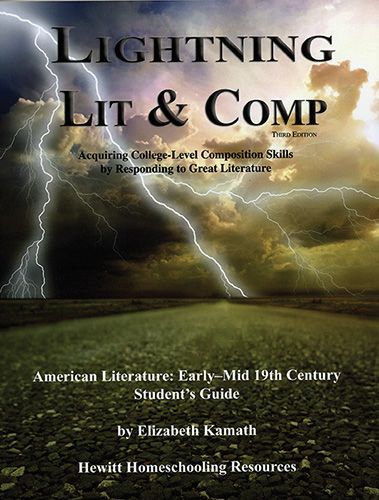
Hewitt Homeschooling provided me with a student guide and a teacher's guide for American Lit: Early to Mid 19th Century. As a former English major, I really liked the choices of literature. These are definitely "living books" (or selections). Some authors covered are: Washington Irving, Frederick Douglass, Edgar Allen Poe, Herman Melville and Henry Wadsworth Longfellow.
Since it is summer vacation, I have to say, we are still working through Unit 1 -- The Autobiography of Benjamin Franklin. In the first chapter of the textbook, the author, Elizabeth Kamath gives a good one-page lead-in intro about Franklin's life and then another page on Pre-19th Century Literature in general. After reading the selection, which I downloaded as a free e-book, I asked my kids the comprehension questions. These are broken into sections of 2 to 7 questions each and go along with the section titles of the book. In retrospect, in future I will give the questions before the reading. My kids were surprised to be asked the names of Franklin's uncles and the number of his siblings and half-siblings (16).
After the comprehension questions comes the section on writing, directly related to the reading. Since the work is an autobiography, the 5-page lesson is about autobiographies and what kinds of details youo might include if you write your own. Following the lesson, there are 8 writing exercises which I thought were quite varied and appealing to students of differing interests and aptitudes. I will be having my kids write several of them -- the author suggests picking two for each selection.
[As an interesting side-note, as I was pre-reading the selection, I came across the passage from which the IEW-style was inspired: where Ben Franklin takes an existing writing, takes notes, re-writes, etc.]
In the Introduction to this course, the author discusses how/why to read literature and poetry. She gives detailed descriptions of figurative language terms (similie, metaphor, personification) and sounds (alliteration, assonance, rhythm, etc.). She goes on to describe how to write a paper, including topic statements, brainstorming, research and outlines. These are quick but thorough passages, probably review for most students at this level. The Appendix offers discussion questions and project suggestions, additional reading and schedules. The author also has suggestions for vocabulary notebooks, reading journals, and more.
Although much of this book could be self-taught, I always think that literature needs discussion, so don't leave your student entirely on their own. Discuss what they have read and what they have written. The Teacher's Guide gives grading tips and checklists for papers, schedules (finish in 1 semester or 1 year), answers to composition questions, and additional writing assignments.
I am excited about adding this literature course into our schedule and will plan to order more in the series! Be sure to check it out for yourself here.
Disclaimer:
I was provided a free copy of the student and teacher guide for Lightning Literature & Composition's American Lit: Early to Mid-19th Century in exchange for an honest review. You can see more reviews from the TOS Crew Members here.
Monday, June 11, 2012
MyMathLab - More than I Need!
Before I get further into this review, let me digress for just a moment. We all know that homeschooling does not always run the way we plan. Life can get in the way. Last month, I unexpectedly had to go in for surgery and then spend several weeks recovering. All that went very well (praise the Lord) but, like often happens, those last 2 or 3 weeks of school slid a bit due to doctor appointments and such. We were also in the midst of our annual homeschool convention, piano recital, dance recital practices and more. (I am so thankful for a helpful husband and children!!!) By the time we got to this review, we were supposed to be on summer vacation and it took some bribery to get as much done as we did.
All that to say, I want you to know up-front that we only spent about a week with this product, a little more than a half-hour a day. I apologize to Pearson, TOS and you! And then, my attitude was one of: "Let's jump in and flail around and see what we can figure out." It wasn't very systematic and I did not seek any help. That is my normal M.O. in life and that is the process we used. Because of that, the first four days were a bit confusing, but on the fifth day, light began to dawn and we were getting the hang of things!
What made it confusing for me, I think, was that it had so much to offer! That sounds crazy. But, it felt like a program that had been developed for "regular" school classrooms (30 kids in a class) and then marketed to homeschoolers. You had options to create and add your own lessons, add due dates to all the assignments, create your own assignments, quizzes, tests, and even add videos. There was a calendar to track assignments. You could keep track of a plethora of students, their progress and achievements. What I like to do with math is hand the text (or video and text) to the child, let them read the instructions, let them do the problems, and then only come to me with questions. It is more like tutoring. We do not generally do quizzes, tests, grading, etc. (Did I hear a loud gasp? I know some of you are nodding and some of you are shaking your heads. It is okay. I understand.) So, all those nifty calendars, assignment sheets and things would be wasted on me.
Anyway, we spent a lot of time just trying to figure out where to start. There are letters to parents and students that say they will tell you where to start, but they were not clear and we were lost for a bit.
As we finally got into the student side, we found that you go to the website, sign in, click on your math course, then click on the first lesson (called "practice units"). There, you find a "text book" page of instruction. As you read, you have tools for highlighting important sections or thumb tacking notes. The cool part about the notes was they could be added by the student or the teacher. So, you could say "This will be on the test." Or, "Honey, I just wanted to take a minute in your stressful day of studying to tell you I love you!" Or "Don't forget this rule!" Or even "After this page, go clean up your room!" (LOL) I really liked the notes, but thought they could size the thumb tack a little smaller. You have the option of showing/hiding the notes as you read.
My daughter, Holly, preferred the text over the video - but that's her learning style. She felt that some of the questions were hard at first, but most of the confusion seemed to be in how it was all being scored. Once she figured that out, things felt more simple and she was getting in the groove.
Along the left side of the "textbook page" are listed the objectives for the lesson. At the top left, you can choose to watch a video with an instructor explaining (using a white board) the lesson you just read. You can watch the whole lesson, or you can watch individual sections by clicking the video icon by each objective. The teacher was nice and perky -- okay, she made me think of a kindergarten teacher -- but she was clear and understandable. (Holly did not find her overly perky like I did.) The videos were nice and clear but sometimes we ran into trouble if we tried to fast forward a bit, the sound would sort of double up on itself or the video didn't seem to change at all. No trouble if you watch from beginning to end.
There is a nice and clearly presented video showing you how to answer questions -- they have a special way of filling in fractions or square roots or other special situations. What we found most confusing at first was just where to start, but we figured it out, so let me share! I'll focus on lesson 1.4. The video for that lesson was 24 minutes. You can close-caption the video in English or Spanish and then play it with or without sound. So, first you read the text and/or watch the video lesson. You get a point for watching the video. My daughter, of course, found the loophole in that you get the point for just clicking on the video. If you close it down 2 seconds later, you still get the point as though you watched the whole thing!
Then you move to the practice questions. For this lesson, it said there were 37 questions -- even though there were only 35. (It could be that they meant points, because you get points for videos and such so that might change the number.) You can see your percent correct and the number you have completed so far as you go along. In the question box, there is a clearly worded question or equation to solve. Below the line, there is space for you to fill in the answer. The big reminder is that if you use fractions, always simplify first or you will get it wrong! I thought the question/answers were very well done.
So, you work the problem and fill in the answer for number one. You can click "Check Answer" to get immediate feedback. The responses are many and nicely varied, including: "good job", "well done," "fantastic," and "nice work!" If you get it right, you get a point and can move on. If you get it wrong, you can re-do the same problem right then. The feedback for a wrong answer is also somewhat varied, but says something like "Sorry! Your answer is incorrect." Then there is a reminder rule given of how to solve the problem. I purposely put in a wrong answer at one point (okay, I really got it wrong!) to see the response. The response was a repetition of the rule for the lesson in using exponents, but did not address what I messed up which was the decimal point.
If you feel you need continued practice, you can then select "Choose Similar Example" and work another problem of the same type. If you are confused, you can click on "Help Me Solve" for a detailed explanation. Or choose "View Example" or "Text" or "Ask Teacher" or "Print." We only tried the first two options. If she needs to ask the teacher, I am standing right next to her.
During the 35+ problems for this lesson, I found it odd that two were repeats. I don't know if this was done on purpose, or if there is a random list of examples, or if there was a glitch. Either way, those 2 were really easy because Holly just looked at the scratch paper where she had worked them the first time!
You must get a 90% on each lesson in order to pass onto the next lesson. I think this is where some major confusion came in during the first couple of days. We are used to texts -- and even video instruction -- where you can flip the pages or move around at your own leisure and decision and look at other areas of the "book." This program appears to be locked down (at least, I did not find a way to unlock it). When you finish the first 8 practice units, you then can take a quiz. When you pass the quiz, you can take the test, and so on. You cannot go ahead or skip around. I do like that you have to get 90% -- working toward mastery.
There were 113 assignments for Algebra I, including homework, quizzes, tests and final exams. Again, you can add more assignments, tests, quizzes, etc. at will. I could be wrong, but I thought that most homeschoolers would not use that feature very much -- unless they were previously public school teachers. I guess I can only really say that I would not use it.
After you complete your practice "homework," you can view a chart of your results for the week. You can see the number you got correct for each lesson, your score, the time spent and the date/time you completed it. The teacher, from his/her vantage point, has access to all this information as well. So, if you have specific due dates, you can make sure they were met. And, of course, the computer grades everything for you. (That is nice.)
So, again, I thought the registration process was easy. I thought the video for "how to answer" was well done. And the lesson text and videos were well done. I liked the ability to highlight or add notes to the text, but I thought otherwise there were too many bells and whistles that most homeschoolers would find superfluous -- and that meant there were a lot of confusing things to wade through in order to find the meat of the product. The instructions for what to do (how to get started) were not intuitively obvious and could be made much simpler. Once you get in there, the math seems to be solid and understandable. I would prefer more flexibility in reading/looking ahead or even trying ahead.
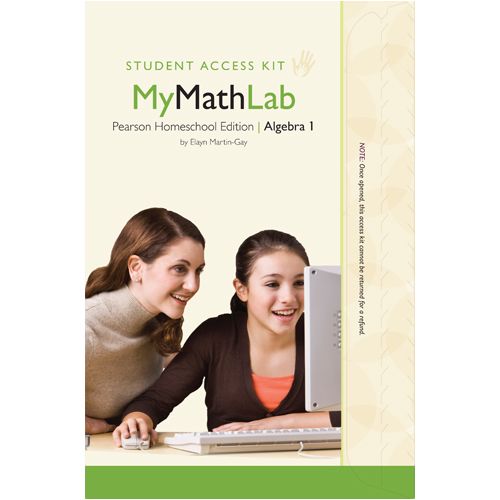
Pearson sells My Math Lab parent access for $30 and the student access for $49.97. You do need both according to the instruction folder. You receive access for eighteen months. You do need separate student access kits for every course. Other courses offered by Pearson are: Developmental Math, Pre-Calculus, Calculus, Trigonometry, Business Math, Statistics, Computer Math, and others. Pearson has other labs besides math -- social studies, reading, and more -- be sure and check those out too!
Disclaimer:
As a member of the TOS Homeschool Crew, I received this product free of charge in exchange for an honest review. To see more reviews of this product, click here.
Subscribe to:
Posts (Atom)